Most international SEO failures aren't strategic. They're structural - and they're expensive to unpick after the fact.
Your UK and IE sites are 94% identical. Google picks one and suppresses the other. Your Irish traffic never arrives and nobody can work out why.
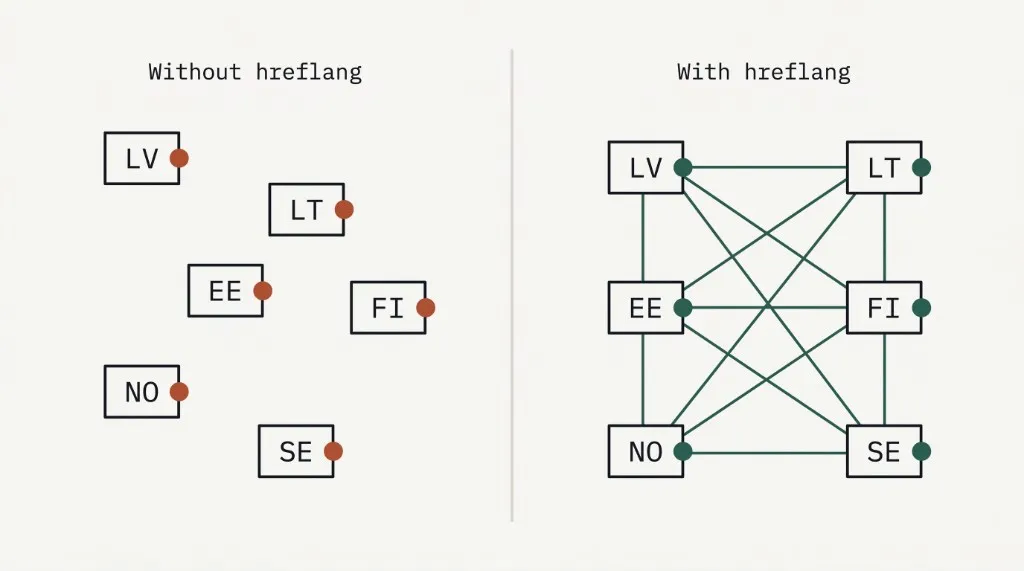
Missing return tags, no x-default, conflicting canonicals. The single most common technical defect we find in multi-market sites - and it silently caps every market you launch.
Swedish buyers don't search using the direct translation of your English keyword. Intent, terminology and competitive landscape differ per market. Machine-translating your UK content into five languages produces five pages nobody searches for.
Launching six markets simultaneously with one content budget produces six weak markets. Sequencing matters more than coverage.
Before you commit budget. Search demand, competitive density, CPC as a proxy for commercial value, and realistic time-to-rank per market. Some markets aren't worth entering, and we'd rather tell you that in month one than month nine.
ccTLD vs subfolder vs subdomain, decided on your actual business structure rather than dogma. Full hreflang matrix with return tags and x-default, self-referencing canonicals, and a governance doc so it doesn't rot the next time someone adds a page.
Market-specific keyword research, content adapted rather than translated, reviewed by someone who works in that market.
AI engines answer in the user's language and cite local sources. A Swedish-language prompt returns a different citation set than its English equivalent. We track prompt sets per market.
We're based in the Baltics and Bulgaria, working across the UK and Nordics daily. Multi-market, multi-currency, multi-language, GDPR-native is not a special project for us - it's the default condition of every client we have. A London agency running a UK-only book of business is learning this on your budget.